Шпаргалка по T-SQL - Часть 1
В этой статье я предоставлен базовый набор t-sql скриптов, предоставляющих информацию о метаданных MSSQL.
Если вы когда-нибудь пытались получить часть этой информации, с помощью GUI, я думаю вы будете приятно удивлены количеством той информации, которую можно получить мнгновенно.
Изучаем сервера
Начнём с запросов, предоставляющих информацию о ваших серверах.
Имена сервера и экземпляра
Select @@SERVERNAME as [Server\Instance];
версия SQL Server
Select @@VERSION as SQLServerVersion;
экземпляр SQL Server
Select @@ServiceName AS ServiceInstance;
Текущая БД (БД, в контексте которой выполняется запрос)
Select DB_NAME() AS CurrentDB_Name;
Как долго ваш SQL Server работает после последнего перезапуска? Помните, что системная база данных tempdb пересоздаётся при каждом перезапуске SQL Server. Вот один из методов определения времени последнего перезапуска сервера.
Select  @@Servername AS ServerName ,
        create_date AS  ServerStarted ,
        DATEDIFF(s, create_date, GETDATE()) / 86400.0 AS DaysRunning ,
        DATEDIFF(s, create_date, GETDATE()) AS SecondsRunnig
FROM    sys.databases
WHERE   name = 'tempdb';

GO
Связанные сервера
Связанные сервера – это соединения, позволяющие SQL Server’у обращаться к другим серверам с данными. Распределённые запросы могут быть запущенны на разных связанных серверах. Полезно знать – является ли ваш сервер баз данных изолированным от других, или он связан с другими серверами.
EXEC sp_helpserver;

--OR

EXEC sp_linkedservers;

--OR

SELECT  @@SERVERNAME AS Server ,
        Server_Id AS  LinkedServerID ,
        name AS LinkedServer ,
        Product ,
        Provider ,
        Data_Source ,
        Modify_Date
FROM    sys.servers
ORDER BY name;

GO
Список всех баз данных
Во-первых, получим список всех баз данных на сервере. Помните, что на любом сервере есть системные базы данных (master, model, msdb, tempdb и distribution, если вы пользуетесь репликацией). Вы, вероятно, захотите исключить эти базы в следующих запросах.
Есть несколько путей для получения списка всех БД на T-SQL и ниже вы увидите некоторые из них. Каждый метод возвращает похожий результат, но с некоторыми отличиями.
EXEC sp_helpdb;

--OR

EXEC sp_Databases;

--OR

SELECT  @@SERVERNAME AS Server ,
        name AS DBName ,
        recovery_model_Desc AS RecoveryModel ,
        Compatibility_level AS CompatiblityLevel ,
        create_date ,
        state_desc
FROM    sys.databases
ORDER BY Name;

--OR

SELECT  @@SERVERNAME AS Server ,
        d.name AS DBName ,
        create_date ,
        compatibility_level ,
        m.physical_name AS FileName
FROM    sys.databases d
        JOIN sys.master_files m ON d.database_id = m.database_id
WHERE   m.[type] = 0 -- data files only
ORDER BY d.name;

GO
Последний бэкап?
Каждый хороший dba должен узнать есть ли у него свежий бэкап.
Select  @@Servername AS ServerName ,
        d.Name AS DBName ,
        MAX(b.backup_finish_date) AS LastBackupCompleted
FROM    sys.databases d
        LEFT OUTER JOIN msdb..backupset b
                    ON b.database_name = d.name
                       AND b.[type] = 'D'
GROUP BY d.Name
ORDER BY d.Name;
Путь к файлу с последним бэкапом.
SELECT  @@Servername AS ServerName ,
        d.Name AS DBName ,
        b.Backup_finish_date ,
        bmf.Physical_Device_name
FROM    sys.databases d
        INNER JOIN msdb..backupset b ON b.database_name = d.name
                                        AND b.[type] = 'D'
        INNER JOIN msdb.dbo.backupmediafamily bmf ON b.media_set_id = bmf.media_set_id
ORDER BY d.NAME ,
        b.Backup_finish_date DESC;

GO
Активные пользовательские соединения
это будет работать только в SQL Server 2012 и выше, в предыдущих редакциях, в dmv sys.dm_exec_sessions отсутствовал столбец database_id. Чтобы узнать в каких БД в данный момент работают пользователи, можно воспользоваться sp_who.
SELECT  @@Servername AS Server ,
        DB_NAME(database_id) AS DatabaseName ,
        COUNT(database_id) AS Connections ,
        Login_name AS  LoginName ,
        MIN(Login_Time) AS Login_Time ,
        MIN(COALESCE(last_request_end_time, last_request_start_time))
                                                         AS  Last_Batch
FROM    sys.dm_exec_sessions
WHERE   database_id > 0
        AND DB_NAME(database_id) NOT IN ( 'master', 'msdb' )
GROUP BY database_id ,
         login_name
ORDER BY DatabaseName;
Изучаем базы данных
Большинство из запросов, представленных в этом разделе, смотрят «внутрь» только одной БД, поэтому не забывайте выбирать нужную БД в SSMS или с помощью команды use database. Также помните, что вы всегда можете посмотреть в контексте какой БД будет выполнен запрос, с помощью select db_name().
Системная таблица sys.objects одна из ключевых для сбора информации об объектах, составляющих вашу модель данных.
В примере U - таблицы. Попробуйте подставить другие значения type в WHERE
USE MyDatabase;
GO

SELECT  *
FROM    sys.objects
WHERE   type = 'U';
Ниже представлен список типов объектов, информацию о которых мы можем получить (смотрите документацию на sys.objects в MSDN)
- AF = статистическая функция (среда CLR);
- C = ограничение CHECK;
- D = DEFAULT (ограничение или изолированный);
- F = ограничение FOREIGN KEY;
- PK = ограничение PRIMARY KEY;
- P = хранимая процедура SQL;
- PC = хранимая процедура сборки (среда CLR);
- FN = скалярная функция SQL;
- FS = скалярная функция сборки (среда CLR);
- FT = возвращающая табличное значение функция сборки (среда CLR);
- R = правило (старый стиль, изолированный);
- RF = процедура фильтра репликации;
- S = системная базовая таблица;
- SN = синоним;
- SQ = очередь обслуживания;
- TA = триггер DML сборки (среда CLR);
- TR = триггер DML SQL;
- IF = встроенная возвращающая табличное значение функция SQL;
- TF = возвращающая табличное значение функция SQL;
- U = таблица (пользовательская);
- UQ = ограничение UNIQUE;
- V = представление;
- X = расширенная хранимая процедура;
- IT = внутренняя таблица.
Расположение файлов баз данных
Физическое расположение выбранной БД, включая основной файл данных (mdf), и файл журнала транзакций (ldf), могут быть получены с помощью этих запросов.
EXEC sp_Helpfile;

--OR

SELECT  @@Servername AS Server ,
        DB_NAME() AS DB_Name ,
        File_id ,
        Type_desc ,
        Name ,
        LEFT(Physical_Name, 1) AS Drive ,
        Physical_Name ,
        RIGHT(physical_name, 3) AS Ext ,
        Size ,
        Growth
FROM    sys.database_files
ORDER BY File_id;

GO
Таблицы
Конечно, Object Explorer в SSMS показывает полный список таблиц в выбранной БД, но часть информации с помощью GUI получить сложнее, чем с помощью скриптов. Стандарт ANSI предполагает обращение к представлениям INFORMATION_SCHEMA, но они не предоставят информацию об объектах, которые не являются частью стандарта (такие как триггеры, extended procedures и т.д.), поэтому лучше использовать представления каталога SQL Server.
EXEC sp_tables; -- Помните, что этот метод вернёт и таблицы, и представления

--OR

SELECT  @@Servername AS ServerName ,
        TABLE_CATALOG ,
        TABLE_SCHEMA ,
        TABLE_NAME
FROM     INFORMATION_SCHEMA.TABLES
WHERE   TABLE_TYPE = 'BASE TABLE'
ORDER BY TABLE_NAME ;

--OR

SELECT  @@Servername AS ServerName ,
        DB_NAME() AS DBName ,
        o.name AS 'TableName' ,
        o.[Type] ,
        o.create_date
FROM    sys.objects o
WHERE   o.Type = 'U' -- User table
ORDER BY o.name;

--OR

SELECT  @@Servername AS ServerName ,
        DB_NAME() AS DBName ,
        t.Name AS TableName,
        t.[Type],
        t.create_date
FROM    sys.tables t
ORDER BY t.Name;

GO
Количество записей в таблице
Таблицы с огромным количеством записей чаще оказывают серьёзное влияние на производительность.
В SSMS мы можем нажать правой кнопкой мыши на любую таблицу, открыть свойства на вкладке Storage и увидеть количество записей в таблице.
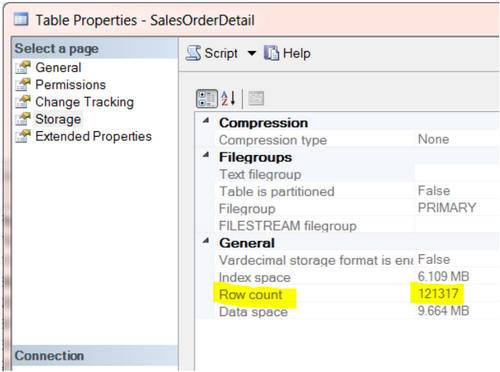
Довольно тяжело собрать вручную эту информацию обо всех таблицах. Опять же, если мы будем писать SELECT COUNT(*) FROM TABLENAME для каждой таблицы, нам придётся очень много печатать.
Скрипт, приведённый ниже, сгенерирует набор инструкций T-SQL для получения количества строк в каждой таблице текущей базы данных.
Select  'Select ''' + DB_NAME() + '.' + SCHEMA_NAME(SCHEMA_ID) + '.'
        + LEFT(o.name, 128) + ''' as DBName, count(*) as Count From ' + SCHEMA_NAME(SCHEMA_ID) + '.' + o.name
        + ';' AS ' Script generator to get counts for all tables'
FROM    sys.objects o
WHERE   o.[type] = 'U'
ORDER BY o.name;
sp_msForEachTable это недокументированная функция, которая «проходит» по всем таблицам в БД и выполняет запрос, подставляя вместо ‘?’ имя текущей таблицы. Так же существует похожая функция sp_msforeachdb, работающая на уровне баз данных.
CREATE TABLE #rowcount
    ( Tablename VARCHAR(128) ,
      Rowcnt INT );

EXEC sp_MSforeachtable 'insert into #rowcount select ''?'', count(*) from ?'

SELECT  *
FROM    #rowcount
ORDER BY Tablename ,
        Rowcnt;

DROP TABLE #rowcount;
Самый быстрый способ получения количества записей – кластерный индекс
Select  @@ServerName AS Server ,
        DB_NAME() AS DBName ,
        OBJECT_SCHEMA_NAME(p.object_id) AS SchemaName ,
        OBJECT_NAME(p.object_id) AS TableName ,
        i.Type_Desc ,
        i.Name AS IndexUsedForCounts ,
        SUM(p.Rows) AS Rows
FROM    sys.partitions p
        JOIN sys.indexes i ON i.object_id = p.object_id
                              AND i.index_id = p.index_id
WHERE   i.type_desc IN ( 'CLUSTERED', 'HEAP' )
                             -- This is key (1 index per table)
        AND OBJECT_SCHEMA_NAME(p.object_id) <> 'sys'
GROUP BY p.object_id ,
        i.type_desc ,
        i.Name
ORDER BY SchemaName ,
        TableName;

-- OR

-- Похожий метод получения количества записей, но с использованием DMV dm_db_partition_stats
SELECT  @@ServerName AS ServerName ,
        DB_NAME() AS DBName ,
        OBJECT_SCHEMA_NAME(ddps.object_id) AS SchemaName ,
        OBJECT_NAME(ddps.object_id) AS TableName ,
        i.Type_Desc ,
        i.Name AS IndexUsedForCounts ,
        SUM(ddps.row_count) AS Rows
FROM    sys.dm_db_partition_stats ddps
        JOIN sys.indexes i ON i.object_id = ddps.object_id
                              AND i.index_id = ddps.index_id
WHERE   i.type_desc IN ( 'CLUSTERED', 'HEAP' )
                              -- This is key (1 index per table)
        AND OBJECT_SCHEMA_NAME(ddps.object_id) <> 'sys'
GROUP BY ddps.object_id ,
        i.type_desc ,
        i.Name
ORDER BY SchemaName ,
        TableName;

GO
Поиск куч (таблиц без кластерных индексов)
Работа с кучами – это как работа с плоским файлом, вместо базы данных. Если вы хотите гарантированно получать полное сканирование таблицы при выполнении любого запроса, используйте кучи. Рекомендуется добавлять primary key ко всем таблицам-кучам.
Метод 1:
Select  @@Servername AS ServerName ,
        DB_NAME() AS DBName ,
        t.Name AS HeapTable ,
        t.Create_Date
FROM    sys.tables t
        INNER JOIN sys.indexes i ON t.object_id = i.object_id
                                    AND i.type_desc = 'HEAP'
ORDER BY t.Name
Метод 2:
Select  @@Servername AS ServerName ,
        DB_NAME() AS DBName ,
        t.Name AS HeapTable ,
        t.Create_Date
FROM    sys.tables t
WHERE    OBJECTPROPERTY(OBJECT_ID, 'TableHasClustIndex') = 0
ORDER BY t.Name;
Метод 3 + количество записей:
Select  @@ServerName AS Server ,
        DB_NAME() AS DBName ,
        OBJECT_SCHEMA_NAME(ddps.object_id) AS SchemaName ,
        OBJECT_NAME(ddps.object_id) AS TableName ,
        i.Type_Desc ,
        SUM(ddps.row_count) AS Rows
FROM    sys.dm_db_partition_stats AS ddps
        JOIN sys.indexes i ON i.object_id = ddps.object_id
                              AND i.index_id = ddps.index_id
WHERE   i.type_desc = 'HEAP'
        AND OBJECT_SCHEMA_NAME(ddps.object_id) <> 'sys'
GROUP BY ddps.object_id ,
        i.type_desc
ORDER BY TableName;
Разбираемся с активностью в таблице
При работах по оптимизации производительности, очень важно знать какие таблицы активно читаются, а в какие идёт активная запись. Ранее мы узнали сколько записей в наших таблицах, сейчас посмотрим как часто в них пишут и читают.
Чтение/запись таблицы:
- Кучи не рассматриваются, у них нет индексов
- Обрабатываются только те таблицы, к которым обращались после запуска SQL Server
Select  @@ServerName AS ServerName ,
        DB_NAME() AS DBName ,
        OBJECT_NAME(ddius.object_id) AS TableName ,
        SUM(ddius.user_seeks + ddius.user_scans + ddius.user_lookups)
                                                               AS  Reads ,
        SUM(ddius.user_updates) AS Writes ,
        SUM(ddius.user_seeks + ddius.user_scans + ddius.user_lookups
            + ddius.user_updates) AS [Reads&Writes] ,
        ( SELECT    DATEDIFF(s, create_date, GETDATE()) / 86400.0
          FROM      master.sys.databases
          WHERE     name = 'tempdb'
        ) AS SampleDays ,
        ( SELECT    DATEDIFF(s, create_date, GETDATE()) AS SecoundsRunnig
          FROM      master.sys.databases
          WHERE     name = 'tempdb'
        ) AS SampleSeconds
FROM    sys.dm_db_index_usage_stats ddius
        INNER JOIN sys.indexes i ON ddius.object_id = i.object_id
                                     AND i.index_id = ddius.index_id
WHERE    OBJECTPROPERTY(ddius.object_id, 'IsUserTable') = 1
        AND ddius.database_id = DB_ID()
GROUP BY OBJECT_NAME(ddius.object_id)
ORDER BY [Reads&Writes] DESC;

GO
Намного более продвинутая версия этого запроса представлена курсором, собирающим информацию по всем таблицам всех баз данных на сервере.
Операции чтения и записи
Кучи пропущены, у них нет индексов
- Только таблицы, использовавшиеся после перезапуска SQL Server
- В запросе используется курсор для получения информации во всех БД
- Единый отчёт, хранится в tempdb
DECLARE DBNameCursor CURSOR
FOR
    SELECT  Name
    FROM    sys.databases
    WHERE    Name NOT IN ( 'master', 'model', 'msdb', 'tempdb',
                            'distribution' )
    ORDER BY Name;

DECLARE @DBName NVARCHAR(128)

DECLARE @cmd VARCHAR(4000)

IF OBJECT_ID(N'tempdb..TempResults') IS NOT NULL
    BEGIN
        DROP TABLE tempdb..TempResults
    END

CREATE TABLE tempdb..TempResults
    (
      ServerName NVARCHAR(128) ,
      DBName NVARCHAR(128) ,
      TableName NVARCHAR(128) ,
      Reads INT ,
      Writes INT ,
      ReadsWrites INT ,
      SampleDays DECIMAL(18, 8) ,
      SampleSeconds INT
    )

OPEN DBNameCursor

FETCH NEXT FROM DBNameCursor INTO @DBName
WHILE @@fetch_status = 0
    BEGIN

----------------------------------------------------
-- Print @DBName

        SELECT   @cmd = 'Use ' + @DBName + '; '
        SELECT   @cmd = @cmd + ' Insert Into tempdb..TempResults
SELECT @@ServerName AS ServerName,
DB_NAME() AS DBName,
object_name(ddius.object_id) AS TableName ,
SUM(ddius.user_seeks
+ ddius.user_scans
+ ddius.user_lookups) AS Reads,
SUM(ddius.user_updates) as Writes,
SUM(ddius.user_seeks
+ ddius.user_scans
+ ddius.user_lookups
+ ddius.user_updates) as ReadsWrites,
(SELECT datediff(s,create_date, GETDATE()) / 86400.0
FROM sys.databases WHERE name = ''tempdb'') AS SampleDays,
(SELECT datediff(s,create_date, GETDATE())
FROM sys.databases WHERE name = ''tempdb'') as SampleSeconds
FROM sys.dm_db_index_usage_stats ddius
INNER JOIN sys.indexes i
ON ddius.object_id = i.object_id
AND i.index_id = ddius.index_id
WHERE objectproperty(ddius.object_id,''IsUserTable'') = 1 --True
AND ddius.database_id = db_id()
GROUP BY object_name(ddius.object_id)
ORDER BY ReadsWrites DESC;'

--PRINT @cmd
        EXECUTE (@cmd)

-----------------------------------------------------

        FETCH NEXT FROM DBNameCursor INTO @DBName
    END

CLOSE DBNameCursor

DEALLOCATE DBNameCursor

SELECT  *
FROM    tempdb..TempResults
ORDER BY DBName ,
        TableName;
--DROP TABLE tempdb..TempResults;
Примечание: курсор не отработает, если у вас в списке есть базы данных с состоянием, отличным от ONLINE.
Представления
Представления – это, условно говоря, запросы, хранящиеся в БД. Вы можете думать о них, как о виртуальных таблицах. Данные не хранятся в представлениях, но в наших запросах мы ссылаемся на них точно так же, как и на таблицы.
Select  @@Servername AS ServerName ,
        DB_NAME() AS DBName ,
        o.name AS ViewName ,
        o.[Type] ,
        o.create_date
FROM    sys.objects o
WHERE   o.[Type] = 'V' -- View
ORDER BY o.NAME

--OR

SELECT  @@Servername AS ServerName ,
        DB_NAME() AS DBName ,
        Name AS ViewName ,
        create_date
FROM    sys.Views
ORDER BY Name

--OR

SELECT  @@Servername AS ServerName ,
        TABLE_CATALOG ,
        TABLE_SCHEMA ,
        TABLE_NAME ,
        TABLE_TYPE
FROM     INFORMATION_SCHEMA.TABLES
WHERE   TABLE_TYPE = 'VIEW'
ORDER BY TABLE_NAME

--OR

-- CREATE VIEW Code
SELECT  @@Servername AS ServerName ,
        DB_NAME() AS DB_Name ,
        o.name AS 'ViewName' ,
        o.Type ,
        o.create_date ,
        sm.[DEFINITION] AS 'View script'
FROM    sys.objects o
        INNER JOIN sys.sql_modules sm ON o.object_id = sm.OBJECT_ID
WHERE   o.Type = 'V' -- View
ORDER BY o.NAME;

GO
Синонимы
Использование синонимов – это редкость, но разбирательства могут вызвать определённые затруднения, если вы к ним не готовы.
Select  @@Servername AS ServerName ,
        DB_NAME() AS DBName ,
        o.name AS ViewName ,
        o.Type ,
        o.create_date
FROM    sys.objects o
WHERE   o.[Type] = 'SN' -- Synonym
ORDER BY o.NAME;

--OR
-- дополнительная информация о синонимах

SELECT  @@Servername AS ServerName ,
        DB_NAME() AS DBName ,
        s.name AS synonyms ,
        s.create_date ,
        s.base_object_name
FROM    sys.synonyms s
ORDER BY s.name;

GO
Хранимые процедуры
(Stored Procedures)
Хранимые процедуры – это группа скриптов, которые компилируются в единственный план выполнения.
-- Хранимые процедуры
SELECT  @@Servername AS ServerName ,
        DB_NAME() AS DBName ,
        o.name AS StoredProcedureName ,
        o.[Type] ,
        o.create_date
FROM    sys.objects o
WHERE   o.[Type] = 'P' -- Stored Procedures
ORDER BY o.name

--OR
-- Дополнительная информация о ХП

SELECT  @@Servername AS ServerName ,
        DB_NAME() AS DB_Name ,
        o.name AS 'ViewName' ,
        o.[type] ,
        o.Create_date ,
        sm.[definition] AS 'Stored Procedure script'
FROM    sys.objects o
        INNER JOIN sys.sql_modules sm ON o.object_id = sm.object_id
WHERE   o.[type] = 'P' -- Stored Procedures
        -- AND sm.[definition] LIKE '%insert%'
        -- AND sm.[definition] LIKE '%update%'
        -- AND sm.[definition] LIKE '%delete%'
        -- AND sm.[definition] LIKE '%tablename%'
ORDER BY o.name;

GO
Добавив простое условие в WHERE мы можем получить информацию только о тех хранимых процедурах, которые, например, выполняют операции INSERT.
WHERE   o.[type]  = 'P' -- Stored Procedures
        AND sm.definition LIKE '%insert%'
ORDER BY o.name
…
Немного модифицировав условие в WHERE, можно собрать информацию о ХП, производящих обновление, удаление или же обращающихся к определённым таблицам.
Функции
Функции хранятся в SQL Server, принимают какие-либо параметры и выполняют определённые действия, либо вычисления, после чего возвращают результат.
-- Функции

SELECT  @@Servername AS ServerName ,
        DB_NAME() AS DB_Name ,
        o.name AS 'Functions' ,
        o.[Type] ,
        o.create_date
FROM    sys.objects o
WHERE   o.Type = 'FN' -- Function
ORDER BY o.NAME;

--OR
-- Дополнительная информация о функциях

SELECT  @@Servername AS ServerName ,
        DB_NAME() AS DB_Name ,
        o.name AS 'FunctionName' ,
        o.[type] ,
        o.create_date ,
        sm.[DEFINITION] AS 'Function script'
FROM    sys.objects o
        INNER JOIN sys.sql_modules sm ON o.object_id = sm.OBJECT_ID
WHERE   o.[Type] = 'FN' -- Function
ORDER BY o.NAME;

GO
Триггеры
Триггер – это что-то вроде хранимой процедуры, которая выполняется в ответ на определённые действия с той таблицей, которой этот триггер принадлежит.
Select  @@Servername AS ServerName ,
        DB_NAME() AS DBName ,
        parent.name AS TableName ,
        o.name AS TriggerName ,
        o.[Type] ,
        o.create_date
FROM    sys.objects o
        INNER JOIN sys.objects parent ON o.parent_object_id = parent.object_id
WHERE   o.Type = 'TR' -- Triggers
ORDER BY parent.name ,
        o.NAME

--OR

SELECT  @@Servername AS ServerName ,
        DB_NAME() AS DB_Name ,
        Parent_id ,
        name AS TriggerName ,
        create_date
FROM    sys.triggers
WHERE   parent_class = 1
ORDER BY name;

--OR
-- Дополнительная информация о триггерах

SELECT  @@Servername AS ServerName ,
        DB_NAME() AS DB_Name ,
        OBJECT_NAME(Parent_object_id) AS TableName ,
        o.name AS 'TriggerName' ,
        o.Type ,
        o.create_date ,
        sm.[DEFINITION] AS 'Trigger script'
FROM    sys.objects o
        INNER JOIN sys.sql_modules sm ON o.object_id = sm.OBJECT_ID
WHERE   o.Type = 'TR' -- Triggers
ORDER BY o.NAME;

GO